

Federal Case Law
In the Federal judicial system, cases start in the U.S. District Courts. Each state has at least one U.S. District Court. Iowa has two. The U.S. District Court for the Northern District of Iowa has locations in Cedar Rapids and Sioux City. The U.S. District Court for the Southern District of Iowa has locations in Des Moines, Davenport, and Council Bluffs. The Iowa Northern and Southern Districts each have a separate U.S. Bankruptcy Court.
Like Iowa, the federal judicial system has two levels of appellate courts. All District Court cases are appealed to one of the thirteen U.S. Court of Appeals. The U.S. Court of Appeals for the 8th Circuit handles appeals from the Iowa, Arkansas, Minnesota, Missouri, North Dakota, and South Dakota U.S. District Courts. Following a decision from a U.S. Court of Appeals, parties can request further review from the U.S. Supreme Court. If the U.S. Supreme Court decides not to hear the case, the U.S. Court of Appeals’ decision becomes the final decision in the case.
When researching federal case law, you want to find mandatory authority.
All U.S. Courts of Appeals and U.S. District Courts must follow U.S. Supreme Court cases. A U.S. Court of Appeals decision, however, is only mandatory authority for the U.S. District Courts within that Circuit. Opinions from other circuits can be used as persuasive authority
to encourage the court to decide the case in the same way. The court does not have to follow decisions from other circuits. For the U.S. District Courts for Northern and Southern Iowa, look for decisions from the U.S. Court of Appeals for the Eighth Circuit and U.S. Supreme Court cases to support your arguments.
To learn more about the federal courts, visit the United States Courts website.
Finding Federal Cases
You can find recent federal court opinions in several places, including the court’s webpage, such as supremecourt.gov, or through GovInfo.gov, but the cases are usually arranged by date to allow the public and lawyers to see the latest cases. When published, federal cases are also arranged by date in several sets of case reporters:
- United States Reports
- U.S. Supreme Court cases (abbreviated as U.S. in citations)
- Federal Reporter
- Has
published
U.S. Courts of Appeals decisions (abbreviated as F., F.2d, F.3d, or F.4th in citations)
- Has
- Federal Supplement
- Has a selection of U.S. District Court decisions (abbreviated as F.Supp., F.Supp.2d, or F.Supp.3d in citations)
- West's Bankruptcy Reporter
- Has a selection of bankruptcy decisions (abbreviated as B.R. in citations)
Even when you retrieve the cases online, you will still use citations for these reporters to tell others where they can find the case.
Searching for Federal Cases Using Google Scholar
Google Scholar allows you to find cases from all U.S. Supreme Court cases and other federal cases since 1923. If your searches are unable to find what you need, you will want to contact or visit a law library and ask for help.
On Google Scholar, begin by selecting Case law
under the search bar. Google Scholar will then offer you three choices, Federal courts,
one state's courts, based on your location, and Select courts . . .
Choose Federal courts
to search all federal courts at once. Choose Select courts
to limit your searches to courts within a particular Circuit within the Federal courts
column, then scroll to the bottom of the page, and click Done.
- Have a case name or citation?
- Type the citation or case name into the search bar.
- Need to search by subject?
- Type your keywords into the search bar. For best results, give Google Scholar three or more words that describe your issue to help it find the best cases for you.
- Need to find cases that discuss a specific United States Code or Code of Federal Regulations Citation?
- Use the citation as a phrase search.
- For example, 11 U.S.C. sec. 727 provides exceptions to receiving a full discharge in Chapter 7 bankruptcy. To find cases that cite that section, type
11 U.S.C. 727
in the search bar.
- For example, 11 U.S.C. sec. 727 provides exceptions to receiving a full discharge in Chapter 7 bankruptcy. To find cases that cite that section, type
- Use the citation as a phrase search.
When looking at the list of results, you will see a linked case name with a citation, the state and court, and the date below the case name.
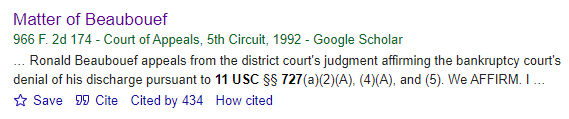
You will also see some of the words around your search terms to help you decide if you want to look at this case. Below each result, you will see links that can help you find other similar cases. The Cited by . . .
link lets you see a list of other cases and articles that cited the case. The How cited
link will let you see the words around the citation in those documents.